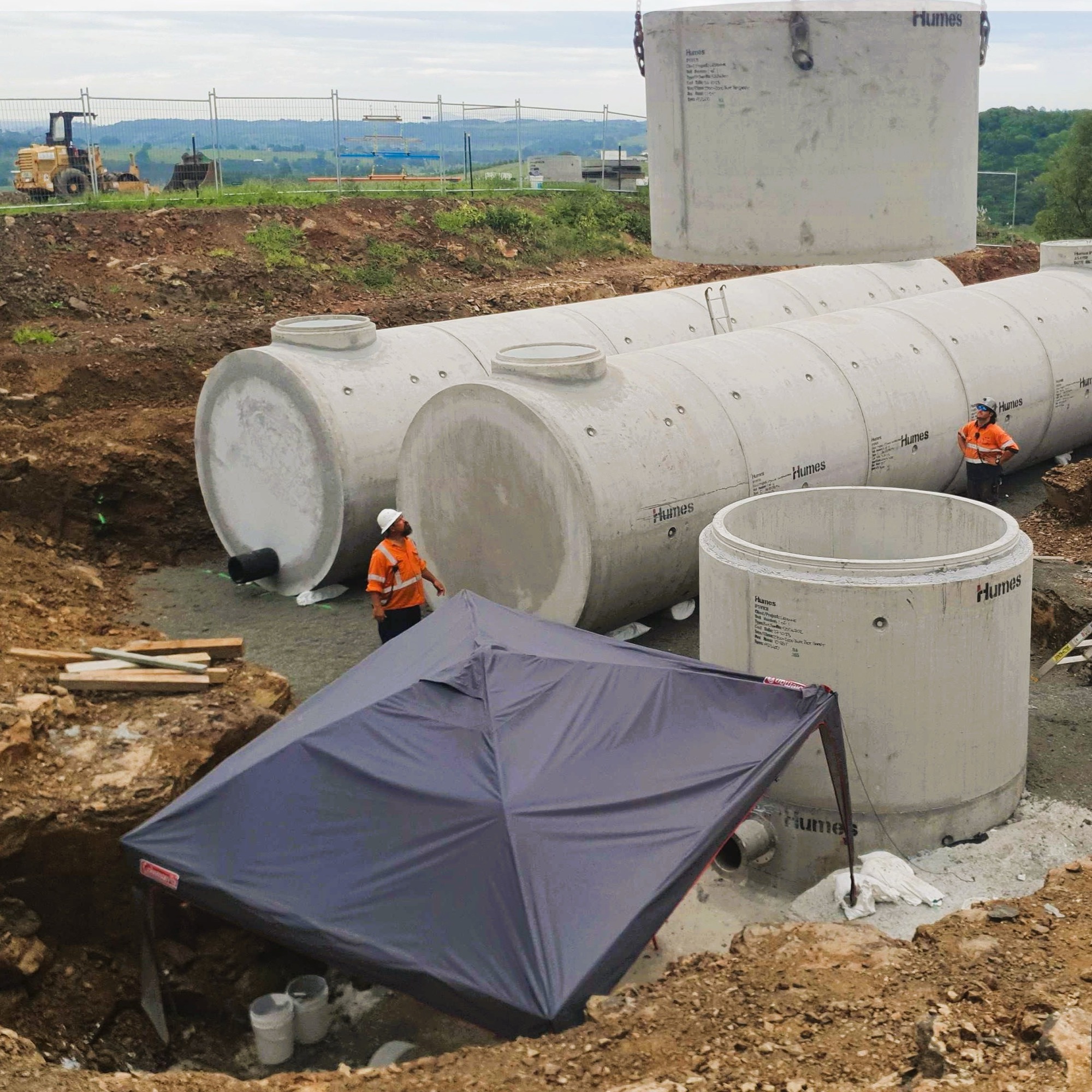

Critical infrastructure delivery, Pineapple Road Sewerage Scheme, Goonellabah NSW
A $7M scheme delivered on budget and incident-free in a post-flood regional environment — unlocking up to 600 flood-free housing lots.
The client
Lismore City Council is the local government authority for the Lismore LGA in the Northern Rivers region of NSW, delivering essential infrastructure to a community that has endured some of the most severe flood events in Australian recorded history. The council had declared a housing emergency in May 2021, before the catastrophic February–March 2022 flood disasters displaced thousands, destroyed infrastructure, and strained the council's capacity to deliver new capital works. Against that backdrop, the council needed to unlock developable, flood-free residential land in Goonellabah — a suburb elevated above the floodplain, identified as a key growth area for the region's recovery housing supply.
Eko was engaged through BASEC Engineering to provide senior project engineering services for the delivery of the Pineapple Road Sewerage Scheme — the critical enabling infrastructure required to open up to 600 new housing lots. The scheme required a new sewerage pump station and over four kilometres of pumped pipeline across a constrained corridor, within a regional construction environment still deeply affected by post-flood supply-chain disruption, material shortages, and workforce pressures. The central question was not simply whether the scheme could be built, but whether it could be delivered on programme, on budget, and without a single safety or environmental incident.
Why it matters
The Northern Rivers was declared a natural disaster zone after the 2022 floods, which inundated large portions of Lismore and surrounds. Recovering families and displaced residents needed flood-free land they could build on — but flood-free land is useless without the infrastructure that unlocks it. The Pineapple Road Sewerage Scheme was not discretionary; it was the single piece of infrastructure standing between a designated growth precinct and 600 development applications that couldn't be processed without it.
The project was jointly funded by Lismore City Council ($5.6 million) and the NSW Government under its Regional Housing Fund ($1.4 million). That structure reflects the scale of political and community expectation attached to the outcome. This was a public commitment, by both a council and a state government, to deliver housing supply for a region in crisis. Delivering it on budget, on time, and clean meant something beyond the technical.
The problem
On paper, it was a civil infrastructure project: a pump station, a pipeline, a defined scope, a programme. In practice it was a delivery challenge compounded at every level. The corridor sat within a landscape still carrying the physical and logistical marks of the 2022 disaster. Wet-weather delays weren't an occasional risk — they were a recurring operational reality. Material procurement timelines that would be manageable on a metropolitan project became genuinely uncertain in a regional supply environment under post-flood pressure. And the consequences of failure weren't abstract: 600 potential lots, a community in recovery, state funding, and a council's credibility were all sitting behind the programme.
The hidden layer underneath the surface complexity was sequencing. The risk wasn't any single delay in isolation — it was the cascade, the way one disrupted delivery, one rain event, one subcontractor slip could compress the critical path and force the kind of corner-cutting that produces safety incidents and environmental breaches.
Disruptions will always occur. It is ensuring the programme has room for them.
Without rigorous, real-time programme adaptation and a senior engineering presence capable of making consequential decisions on site — not from a CBD office — the scheme risked the kind of delay and incident chain that stains both projects and reputations. Post-disaster delivery environments do not forgive late responses.
Our approach
- Provided Senior Project Engineer oversight for the full delivery of the scheme, with Eko's representative embedded on behalf of Lismore City Council through BASEC Engineering — a single, accountable, technically capable presence from mobilisation to completion.
- Navigated environmental constraints in a flood-prone landscape, applying site-specific controls and monitoring calibrated to the actual risk profile of the corridor, not a generic CEMP template lifted from a previous project.
- Managed significant wet-weather delays through constant programme adaptation and re-sequencing — identifying flex in the programme and repositioning resources to maintain forward progress without sacrificing quality or compliance.
- Resolved material delivery challenges in a post-flood regional supply environment by identifying lead times early, maintaining supplier relationships proactively, and sequencing works to avoid critical-path exposure.
- Delivered client-side construction management ensuring quality and safety throughout — maintaining zero safety incidents and zero environmental breaches across the full construction period as a non-negotiable operating standard.
- Led community and stakeholder engagement throughout, keeping the council and affected residents informed and managing the reputational sensitivities of a highly visible recovery project.
The result
Lismore City Council completed the Pineapple Road Sewerage Scheme in September 2024, as reported in the council's official media release and confirmed by The Northern Rivers Times and the Lismore App. The scheme involved a new sewerage pump station and over four kilometres of pipeline, created 30 local jobs, and connects to the council's established wastewater network — unlocking development opportunity for up to 600 new housing lots on flood-free land in Goonellabah that developers had previously been unable to develop because the enabling infrastructure wasn't in place. The project was delivered on budget, jointly funded by Lismore City Council ($5.6 million) and the NSW Government Regional Housing Fund ($1.4 million).
The delivery outcomes — completed on schedule, on budget — are Lismore City Council's achievement. Eko contributed embedded senior project engineering through BASEC Engineering: the engineering oversight and adaptive programme management that made clean delivery possible in a post-disaster regional environment where those outcomes were far from guaranteed.
For a community that had been told 600 new homes were coming, infrastructure delivered on time and without incident is not a footnote. It is the thing that makes the promise real.
Program context
Published sources reference outcomes from the scheme; all outcomes belong to Lismore City Council as project owner, with Eko's role as embedded senior project engineering through BASEC Engineering. Lismore City Council media release, September 2024: completed in partnership with BASEC Engineering, DGP Water and Ledonne Constructions; new pump station and over four kilometres of pipeline; 30 local jobs; jointly funded ($5.6M LCC, $1.4M NSW Regional Housing Fund). The Northern Rivers Times (26 Sept 2024) and the Lismore App (23 Sept 2024) reported the opening, funding split, and Mayor Steve Krieg's confirmation that developers previously couldn't get DAs approved because the infrastructure wasn't in place.
What it means to you
Your next project isn't going to fail because of a bad scope. It's going to get stuck because nobody fixed the programme when the first disruption hit.
You're managing civil or infrastructure works somewhere in Australia right now. Your programme is tight. Your subbies are stretched. The weather doesn't care about your handover date. And somewhere above you, someone is watching the milestone tracker, waiting for a reason to ask questions you don't want to answer. You've done everything right on paper — approvals in order, CEMP submitted, safety plan signed off — and yet you can feel the pressure building. Not from one thing. From the accumulation of small slippages nobody has a solution for.
Here's what most project managers discover too late: the programme didn't fail at the point of the disruption. It failed weeks earlier, when the programme had no flex built in to absorb one. The wet-weather event, the late concrete delivery, the subcontractor who pulled two guys to another job — none of those individually should derail a project. But on a programme with zero contingency sequencing and no senior engineer authorised to re-sequence in real time, each one becomes a crisis.
Having a CEMP is not the same as running one. Most sites discover that difference after an inspection, not before.
What happened on the Pineapple Road Sewerage Scheme is a precise illustration of what it takes to hold a programme together when the environment is working against you. Post-flood supply chains. Elevated weather risk. A constrained regional subcontractor market. A council and a state government both publicly committed to a housing outcome. The geography is different; the stakes are the same. The only thing standing between the intended outcome and a very different story was a senior engineering presence that was there, every day, making the calls that kept the programme moving.
Our approach to infrastructure delivery is built on embedded senior oversight — a field-present, technically authorised engineering resource with the expertise to re-sequence a programme in real time, the authority to make consequential decisions without escalating every one, and the accountability to ensure nothing slips on quality or compliance. Not a project management service delivered from a laptop in a CBD office. A senior engineer on site, in the corridor, in the room where the decisions get made.
Sources & references
Pipeline length (over 4 km) and 30 local jobs: Lismore City Council official media release, September 2024; council project page, lismore.nsw.gov.au.
Funding split ($5.6M LCC, $1.4M NSW Regional Housing Fund): Lismore City Council media release, Sept 2024; confirmed in The Northern Rivers Times, Lismore App, and Janelle Saffin MP media release.
Housing emergency declared May 2021: Lismore City Council, quoted in Lismore App, Sept 2024.
600 lots unlocked; land previously undevelopable without this infrastructure: Mayor Steve Krieg, The Northern Rivers Times (26 Sept 2024) and Lismore App (23 Sept 2024).
Works commenced June 2023, completed September 2024: Lismore City Council YourSay key-dates page.
2022 Northern Rivers flood disaster context: NSW Reconstruction Authority, public regional recovery documentation, 2022–2024.