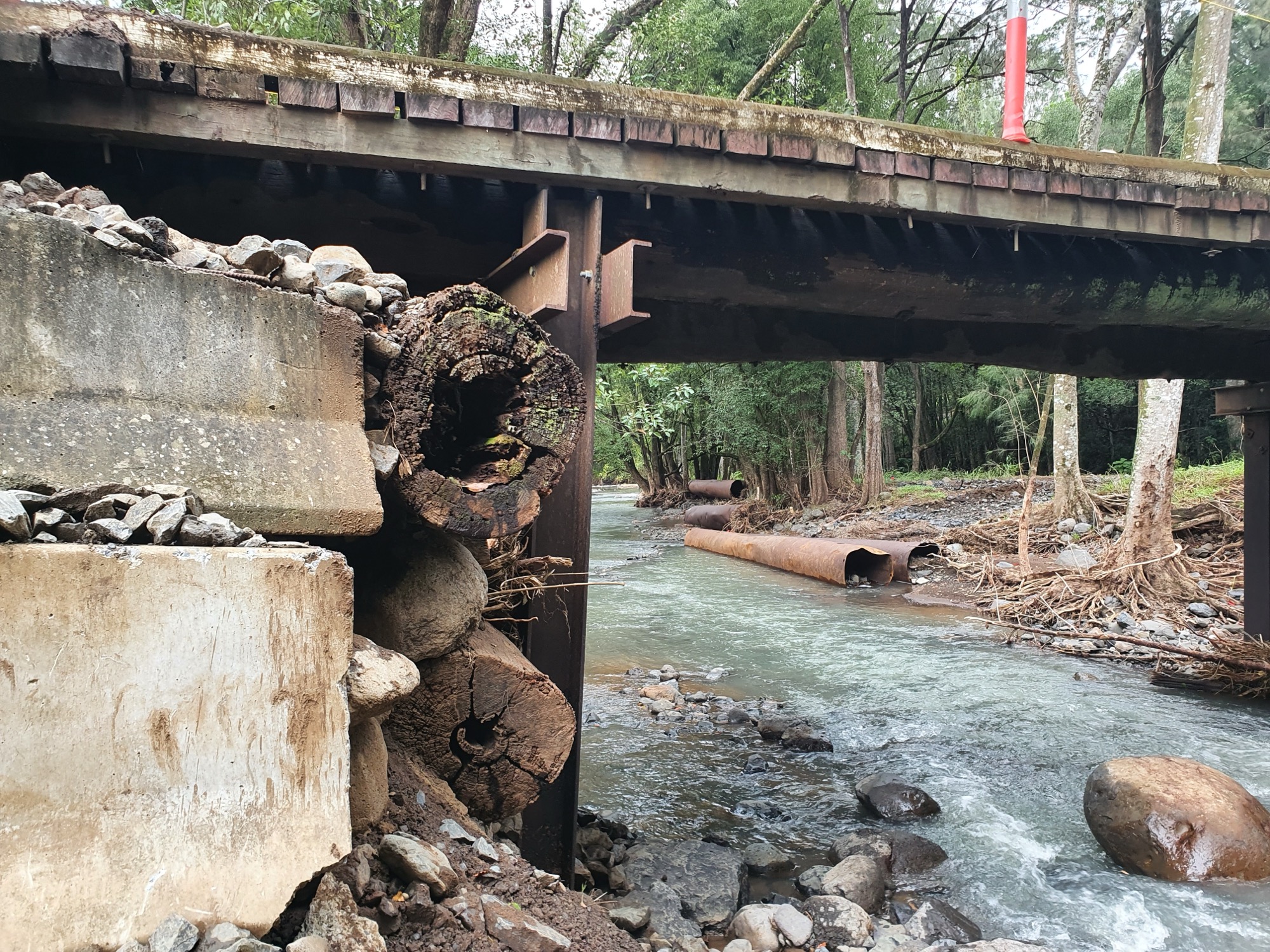

Flood recovery asset assessment, Lismore City Council, NSW
400+ building assets and rural bridges inspected and documented to grant-audit standard — opening the recovery-funding pathway.
The client
Lismore City Council is the local government authority responsible for civil infrastructure across the Northern Rivers region of NSW — roads, bridges, and community buildings serving a widely dispersed rural population. In February and March 2022, Lismore experienced what has since been described as one of the most catastrophic flood events in Australian recorded history. Floodwaters exceeded all previous records and inundated large sections of the urban area and surrounding rural network, causing infrastructure damage on a scale that overwhelmed normal assessment and repair processes.
Eko Engineering was engaged as a specialist subcontractor through BASEC Engineering, which held the primary contract with the council. Eko was deployed into the field in the weeks following the disaster to do the work that sits before any repair can begin — systematic, asset-by-asset inspection and documentation across a damaged network of bridges, roads, and council buildings. The central question wasn't simply what had broken. It was: what do we have, what condition is it in, and what documentation do we need to access the funding to fix it?
Why it matters
The 2022 Northern Rivers floods affected more than 4,000 properties in Lismore alone and triggered one of the largest natural disaster recovery responses in NSW history. State and federal governments committed significant reconstruction funding, including programs administered through Resilience NSW and the jointly funded Disaster Recovery Funding Arrangements (DRFA). But that funding doesn't flow automatically — it flows to councils that can demonstrate, with documented evidence, exactly what was damaged, to what degree, and at what estimated cost to repair.
Lismore is not an isolated case. It is a preview. The councils that recovered fastest were not necessarily those with the least damage — they were those whose asset condition data was defensible enough to support a funding application under pressure, at speed, with scrutiny. The organisations that struggled were those whose documentation gaps became funding gaps.
The problem
When the floodwaters receded, the council faced a task that would have challenged any organisation: assess damage to hundreds of bridges, roads, and buildings across a geographically dispersed network, document each asset to a standard that would withstand grant auditing, and do it fast enough that the funding process could begin. Recovery programs were open, but they required defensible, asset-by-asset condition data to process claims. The clock was running.
The deeper problem wasn't the flood damage itself — damage can be repaired when funding arrives. It was that without structured, systematic baseline documentation of what existed before the event, and rigorous post-event condition reporting at the individual asset level, the link between disaster and funding entitlement can't be made with confidence. Assessments prepared without methodology, or without full asset-register coverage, create gaps. Funding bodies find those gaps. Gaps become delays.
The flood didn't stop the funding. The missing baseline did.
Every day without a completed condition report was a day the grant application couldn't be finalised. Every asset left unassessed was a potential claim left on the table. The problem was not what the water destroyed — it was what had never been properly recorded, and what now had to be captured under pressure, in damaged conditions, at scale.
Our approach
- Conducted Level 1 bridge inspections across the flood-damaged rural road network — systematic field inspection of each structure in its post-flood state, applying a consistent condition rating methodology that could withstand external audit and support repair prioritisation and grant submission.
- Completed condition inspections of over 400 council building assets — a disciplined, repeatable assessment process deployed across geographically dispersed sites under post-disaster access conditions, each building inspected and recorded individually rather than aggregated into class-level estimates.
- Prepared asset-by-asset condition reports submitted to council for immediate action and grant applications — structured to match the evidentiary requirements of recovery funding programs: specific, referenced, and defensible at the level of the individual asset.
The result
Eko completed condition inspections of over 400 council building assets and conducted Level 1 bridge inspections across the rural road network within the engagement period. The documentation set was submitted to Lismore City Council and used to support grant applications under the state and federal disaster recovery funding framework. Where the documentation was in place, the funding pathway was open: the grant process could advance, and repairs communities depended on could be scoped, contracted, and begun.
In a post-disaster recovery context, the value of a completed, defensible asset condition report can't be separated from the outcome it enables. Documentation is not an administrative step that sits before the real work — it is the mechanism that determines whether the real work gets funded at all.
Web search conducted — no qualifying published outcomes found for this specific Eko engagement within 2017–2026. General DRFA and Northern Rivers reconstruction reporting is available as program context only and is not attributed to this engagement.
What it means to you
You run a tight site. But what happens when the flood hits the one you managed three years ago — and nobody can find the condition records?
You're the kind of project manager who checks the weather radar before the crew arrives. You walk the perimeter before the toolbox talk. You know the consent conditions better than the subcontractors who should. Your reputation is built on being the person who has it sorted — before anyone asks. That reputation takes years to build and one undocumented incident to crack.
Here's the part most project managers don't see coming. The risk that keeps you up at night is usually a compliance breach during active works — a silt fence that failed overnight, a public complaint, a surprise inspection. Those are real. But the risk that actually stops recovery, stops funding, and stops repairs is quieter. It lives in the documentation layer. It is the absence of a baseline that can be defended under scrutiny when something goes wrong — not just in the week it happens, but months later when a funding body asks what condition that bridge was in before the event, and the answer is a folder of inconsistent records from three different contractors.
The flood didn't stop the funding. The missing baseline did.
In Lismore in 2022, the disaster was the flood. But the projects that got stuck didn't get stuck because of water. They got stuck because the documentation needed to convert damage into a defensible grant claim wasn't there in a form funding bodies could process at speed. Hundreds of assets. Hundreds of individual claims. Where that data existed and was credible, the pathway to funding was open. Where it didn't, the gap became the delay.
Our approach to post-event and pre-event asset assessment is built on one principle: every asset in the register gets inspected individually, rated consistently, and documented to the standard a funding auditor would require — not the standard that feels adequate on the day. No summary estimates. No class-level averaging. The same rigour that allowed us to move fast in Lismore's post-flood environment is what lets a project manager walk into a board meeting, a council review, or an EPA inspection with numbers they can stand behind.
Sources & references
2022 Lismore flood described as one of the most catastrophic in Australian recorded history: NSW Government, Northern Rivers Reconstruction Corporation, Reconstruction Update, 2022–2023.
DRFA requires documented evidence of asset damage to support grant claims: Australian Government, Department of Home Affairs, Disaster Recovery Funding Arrangements Guidelines (current edition).
Resilience NSW post-disaster recovery framework and funding: NSW Government, Resilience NSW Annual Report 2022–2023.
4,000+ properties affected in Lismore: NSW Government, Northern Rivers Flood Inquiry, 2022 (figure relates to the broader event; Eko's engagement was limited to council infrastructure assets).