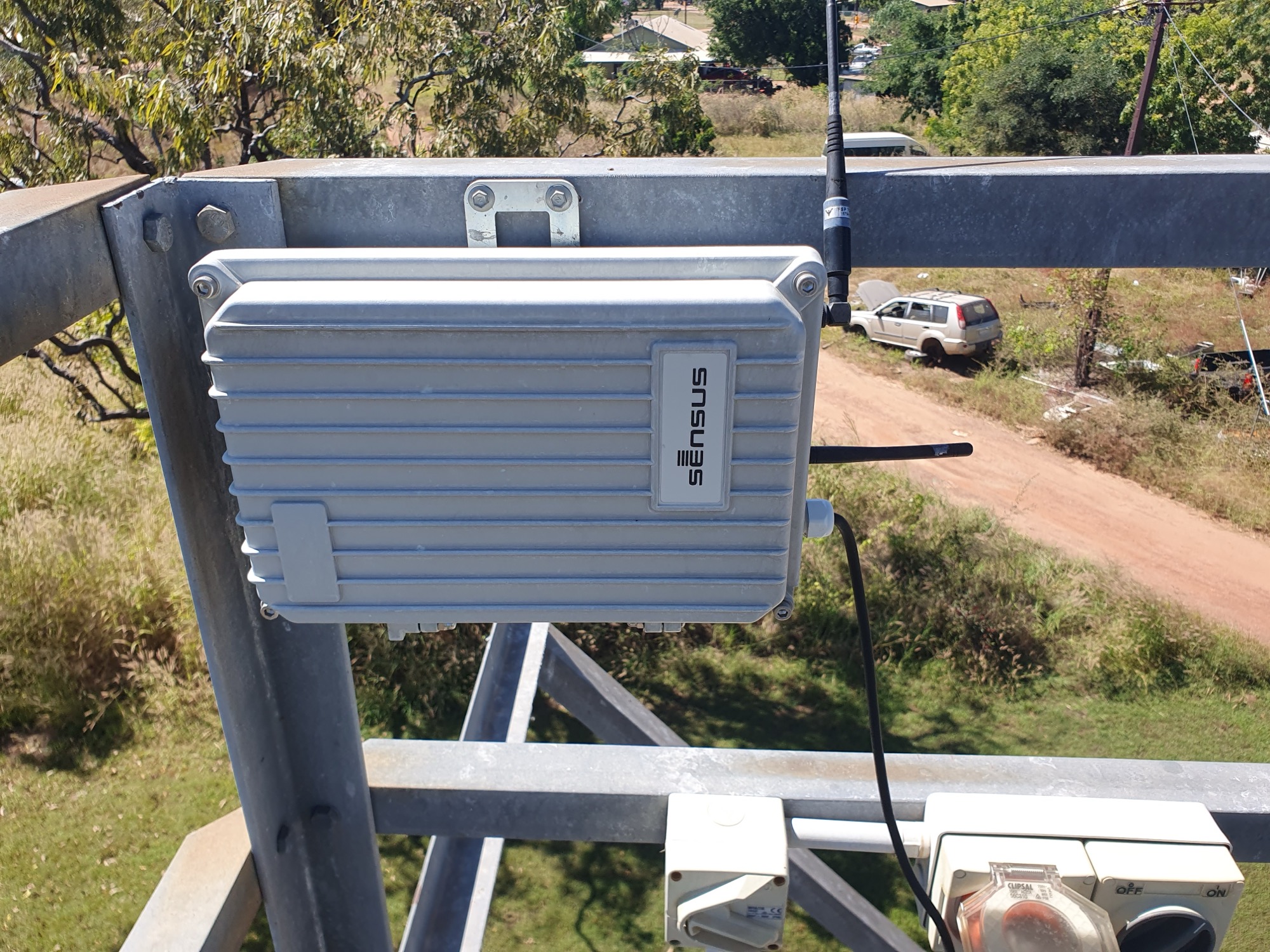
Smart meter installation, Darwin mains water reticulation network
1,000+ smart meter devices installed, activated, and validated — the verified data layer beneath a program that has since saved 438 ML.
The client
Power and Water Corporation (P&W) is the NT Government's integrated utility, delivering water, sewerage, and power across one of Australia's most geographically vast and climatically extreme service areas. Darwin endures a pronounced wet-dry cycle, significant seasonal demand variation, and infrastructure challenges with no direct parallel in southern urban networks. Managing Darwin's mains reticulation network means managing a critical public asset across hundreds of kilometres of pipe, serving a base with limited redundancy if the network underperforms.
P&W had been building toward a broader digital water management program — a shift from periodic manual reads toward real-time consumption visibility, proactive leakage detection, and customer engagement through digital portals. Smart metering is the foundation layer; without it, everything upstream operates on incomplete or unreliable data. P&W engaged Eko to deliver the installation, activation, and quality assurance of smart meter add-on devices for Darwin's reticulation network. The central question was straightforward: could the existing meter estate be upgraded into a foundation that would actually support the digital program it was meant to enable?
Why it matters
Non-revenue water — produced and distributed but never billed — remains one of the most significant and least visible cost pressures facing Australian water utilities. Leakage, metering inaccuracies, and data gaps all contribute. In the NT, extreme temperatures, aggressive soil movement, and ageing infrastructure accelerate both physical losses and data degradation. A meter that records inaccurately is not a neutral problem; it is an ongoing source of revenue leakage, billing disputes, and operational blind spots that compound over time.
The case for smart metering in most contexts is not primarily technological. It is financial and strategic. Utilities that cannot verify what their network is actually delivering cannot manage it effectively — cannot detect leaks in real time, validate consumption for billing, or give customers the transparency they increasingly expect.
The problem
The surface problem was infrastructure. The deeper problem was data integrity. A smart meter that records incorrectly is in some respects worse than no smart meter at all — it gives the appearance of coverage while generating numbers that can't be trusted. Without systematic quality assurance at every device, the investment would produce a network that looked upgraded on a map but kept underperforming in practice.
Installing a meter is not the same as getting reliable data. The gap between those two things was exactly where the problem lived.
The consequence of leaving that gap unaddressed wasn't theoretical. Every meter returning bad data represents consumption that can't be accurately billed, leakage that can't be detected, and a customer-engagement program built on a foundation that would eventually produce disputes. P&W needed not just installation, but validation — proof that each device was working correctly before the network was handed over as functional.
Our approach
- Installed and activated over 1,000 smart meter add-on devices across Darwin's mains reticulation network, applying consistent installation practice across the full estate rather than treating it as a volume exercise with quality secondary.
- Delivered quality assurance across the full roll-out, establishing a verified baseline so P&W's digital program would be built on confirmed data rather than estimated performance.
- Integrated devices with P&W's existing digital frameworks and customer portals, ensuring the field installation connected directly to the platform layer without rework or manual bridging.
The result
Over 1,000 smart meter add-on devices were installed, activated, and validated across Darwin's mains reticulation network, with full integration into P&W's digital water management platform. What this delivers is not just a count of meters in the ground — it is a verified, connected estate that P&W can rely on as the data layer for everything that follows: real-time consumption visibility, proactive leakage detection, and customer tools that depend on numbers that are actually correct.
Eko's role was specific and deliberate: install correctly, validate rigorously, ensure the data reached the right people. P&W provided the program vision, coordinated across NT Government agencies, and ensured every notified leak was actioned and repaired. Accurate data from the field meeting a capable, responsive program owner is what made the results possible.
Those results have since been publicly reported. P&W's 2025 Annual Drinking Water Quality Report identifies the public-housing smart water meter initiative as the primary driver of the Living Water Smart demand management program. Since 2023–24, 1,625 smart water meters have been installed across Darwin to support early leak detection and faster repairs. In the first half of 2025–26, the program saved approximately 438 megalitres through proactive leak detection, monitoring technology, and commercial customer support.
The data was Eko's contribution. The action was P&W's. These savings are P&W's achievement — what Eko contributed was the data foundation that made them visible, and therefore fixable.
Program context
The savings outcomes above are drawn from Power and Water Corporation's own publicly published reporting. They are cited to provide independent, verifiable context for the program Eko contributed to — not as a claim of Eko-attributable savings. Source: P&W 2025 Annual Drinking Water Quality Report (1 July 2024 – 30 June 2025). Secondary reporting: Inside Water, 'Water demand management program beats NT savings target', May/June 2026.
What it means to you
Your smart meters are in. So why is the bill still doing whatever it wants?
You manage assets, budgets, and people who expect answers. Whether you're a facilities or operations manager staring down a quarterly water bill you can't fully explain, or a sustainability officer trying to build a credible efficiency case for a board that wants numbers — the problem feels the same. You've done the right things: installed meters, run reports, pushed for efficiency. And still the bill climbs, the data feels unreliable, and the next presentation is coming faster than you'd like.
Here's the part most people miss. The meters are almost never the problem. The problem is what happens after they go in the ground. Installation gets signed off. Integration gets ticked. And then, quietly, the numbers come back wrong, or inconsistent, or correct enough that nobody questions them until something expensive happens. That's not bad luck. That's what happens when validation gets skipped.
A smart meter program without validation and consistent maintenance is not an upgrade. It is a more expensive version of the same blind spot you had before.
In Darwin, Power and Water Corporation faced the same question at a different scale — a network of over 1,000 devices, a digital program that depended on those devices performing correctly. The easy thing was to install and move on. What Eko did instead was validate every device, one by one, before the network was handed over as functional. The result was a verified, connected estate that became the data foundation for a program that has since saved 438 megalitres. That's not a Darwin problem solved. That's a methodology proven — and it works the same whether the network is a utility grid in the NT or a commercial facility in Brisbane or a mixed-use development on the Gold Coast.
We call this the data-first approach. Before any hardware recommendation, before any efficiency program, the foundation gets checked: data quality assessed, connectivity confirmed, baseline validated. It's disciplined, unglamorous work — and the only sequence that produces results you can stand behind in a board meeting, a sustainability report, or an audit.
Sources & references
Darwin climate and infrastructure context: Bureau of Meteorology, Climate Data Online, Darwin Airport station records.
Non-revenue water context: Water Services Association of Australia (WSAA), National Performance Report (various years).
P&W service area and digital program context: Power and Water Corporation Annual Reports and publicly available program documentation.
Living Water Smart savings — 438 ML, 1,625 meters since 2023–24, smart meter initiative identified as primary program driver: P&W 2025 Annual Drinking Water Quality Report (1 July 2024 – 30 June 2025).
Secondary reporting: Inside Water, 'Water demand management program beats NT savings target', May/June 2026.